


Заполните Ваши данные, мы с вами обязательно свяжемся

Contact


Contact
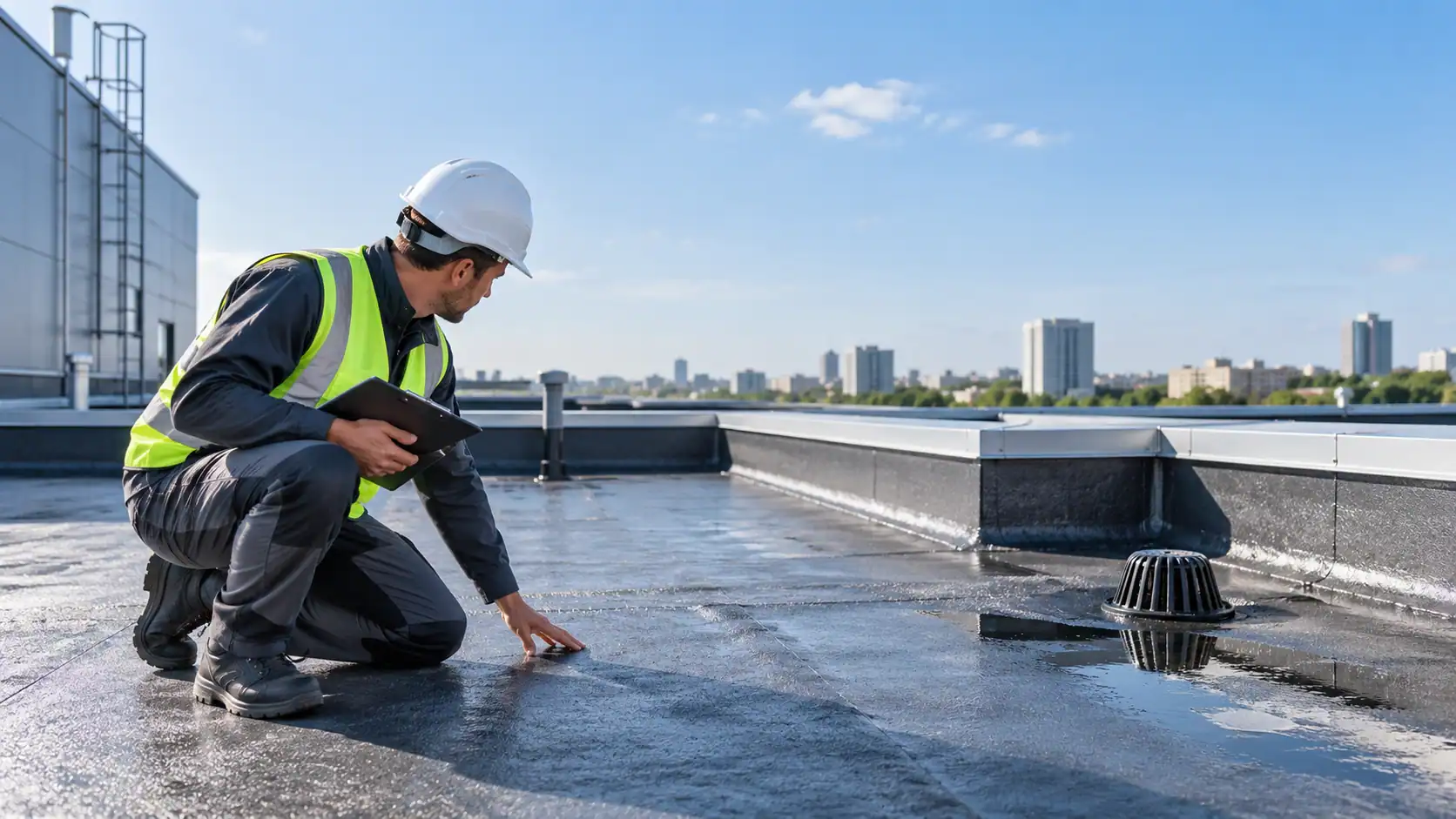
Roof inspection is a comprehensive assessment of the condition of the roofing membrane, waterproofing, thermal insulation, substrate, drainage system, junction details, and, where necessary, the load-bearing roof structures. Its purpose is not only to identify visible damage, but also to determine the causes of leaks, moisture penetration, deformation, and premature deterioration of the roofing system.
The roof is constantly exposed to precipitation, solar radiation, temperature fluctuations, wind loads, and operational impacts. Even a minor defect at a junction or a loss of watertightness can eventually lead to wet insulation, corrosion of metal elements, damage to interior finishes, and reduced building performance.
Therefore, a professional roof inspection should answer not only the question “where is the defect located?” but also more important questions – why it occurred, how extensive the damage is, and which repair method is technically justified.
Inspecting only the external roofing surface is not sufficient. A roof is a system of interconnected elements, and the source of a problem may be located far from the point where water appears inside the building.
For example, a leak visible on the ceiling does not necessarily mean that the waterproofing defect is located directly above that area. Water can migrate within the roof build-up, along structural slabs, metal elements, or insulation and enter the interior at a considerable distance from the original defect.
For this reason, a technical roof inspection assesses the condition of the entire accessible roof system.
| Element | What Is Inspected |
|---|---|
| Roof Covering | Tears, cracks, blisters, punctures, corrosion, seam defects |
| Waterproofing | Watertightness, condition of joints and junctions |
| Substrate | Deformations, cracks, localized settlement |
| Thermal Insulation | Moisture damage, loss of performance, non-uniformity |
| Vapor Barrier | Integrity and possible installation defects |
| Drainage | Drains, gutters, slopes, standing water |
| Junctions | Parapets, walls, shafts, pipes, rooflights, and penetrations |
If it is necessary to assess not only the roof but also other structural elements of the facility, a comprehensive technical inspection of buildings and structures is carried out.
A roof inspection is especially important when leaks, damp spots, mold, damage to the finishes of the upper floor, or visible deterioration of the roofing are detected.
However, inspections are also carried out before any critical signs appear. They may be required before major repairs, building reconstruction, property acquisition, acceptance of completed roofing works, or installation of additional equipment on the roof.
For example, before installing solar panels, ventilation equipment, or other structures, it is important to understand the condition of the existing roofing and load-bearing system. Additional loads or new roof penetrations should not reduce the reliability of the roof.
An inspection is also advisable after severe weather events if there is a risk of damage to the roofing, fastening elements, or drainage system.
In everyday language, these terms are often used as synonyms, but from an engineering perspective they can be distinguished.
The roof covering is the external protective layer of the system that is directly exposed to weather and provides watertightness.
The roof structure is a broader concept. In addition to the roof covering, it may include rafters, load-bearing elements, battens, insulation, vapor barrier, and other structural components.
For this reason, the scope of inspection depends on the task.
If the objective is to identify the source of a local leak in a flat membrane roof, inspecting the roof covering and key junctions may be sufficient. If the building is being prepared for reconstruction or roof deformation has been detected, the load-bearing structures must also be inspected.
A high-quality inspection begins not with instruments, but with an analysis of the available information.
Specialists determine the roof structure, its service period, repair history, locations of previous leaks, and any alterations made after construction.
The inspection then usually proceeds through several stages.
Where available, design drawings, as-built documentation, information on materials, and the results of previous inspections and repairs are reviewed.
This makes it possible to understand the original roof build-up and compare the design solutions with the actual condition of the facility.
It is especially important to determine whether any works were carried out after construction that could have affected the roof. For example, the installation of ventilation shafts, antennas, outdoor equipment units, and engineering services often requires additional roof penetrations.
At this stage, visible damage and characteristic signs of improper roof system performance are recorded.
The specialist assesses the roof surface, the condition of seams and fasteners, parapets, drains, gutters, junctions, and areas where engineering services pass through the roof.
Particular attention is paid to areas where water or snow accumulates, locations where the roof geometry changes, and previously repaired sections.
If a visual inspection is not sufficient, additional investigation methods are used.
Depending on the roof structure and the task, these may include measurements of geometry and slopes, moisture measurements, thermal imaging, local opening of the roof build-up, and other diagnostic methods.
The method should not be selected according to the principle that “the more instruments, the better.” It should be chosen based on the specific hypothesis that needs to be verified.
Simply recording a defect does not constitute a complete inspection.
For example, membrane blistering may be caused by moisture within the roof build-up, problems with the vapor barrier, or installation defects. In such a case, a local surface repair would eliminate the visible symptom but not the original cause.
For this reason, after the inspection, it is necessary to establish the relationship between the detected damage and the operating conditions of the roof.
The nature of roof damage depends on the roof type, building structure, quality of the original work, and operating conditions.
Flat roofs often have problems such as loss of seam watertightness, membrane damage, standing water, defective junctions, and drainage outlet issues.
Metal roofs are associated with other typical problems – corrosion, damage to protective coatings, deformation of metal sheets, fastener defects, and loss of tightness at joints.
| Sign | Possible Cause |
|---|---|
| Leaks After Rain | Damage to the roof covering, seam, or junction |
| Standing Water | Insufficient slope or drainage problems |
| Roof Blistering | Moisture or water vapor pressure within the roof structure |
| Cracks | Material aging or substrate deformation |
| Wet Insulation | Failure of waterproofing or vapor barrier |
| Metal Corrosion | Moisture exposure and damage to the protective coating |
| Roof Deformation | Problems with the substrate or load-bearing structures |
| Condensation | Problems with thermal performance or ventilation |
The same visible sign may have different causes. Therefore, prescribing repairs based only on a photograph of the defect, without analyzing the roof structure, can be risky.
Finding the source of a leak is one of the most common reasons for conducting a roof inspection.
The main difficulty is that the point where water enters the roof and the point where it appears inside the building may not coincide.
Water can spread between roof layers, along seams, slabs, or structural elements. Therefore, simply inspecting the area directly above a damp spot does not always provide the answer.
Diagnostics begin with an analysis of the circumstances under which the leak occurs.
It is important to determine:
— whether water appears only after heavy rainfall
— whether the problem occurs during snowmelt
— whether the leak depends on wind direction
— whether the moisture is persistent
These observations help distinguish a defect in the external waterproofing from condensation or damage to internal utility systems.
A thermal imaging camera can be used as an auxiliary tool to identify temperature irregularities.
Areas with wet insulation may behave differently thermally compared with dry areas, so under suitable conditions thermal imaging can help identify potentially problematic zones.
However, thermal imaging should not be considered a universal method for detecting roof leaks. The results are influenced by air temperature, solar exposure, wind, the roof build-up, and the properties of the materials.
For this reason, thermograms should be interpreted together with the results of visual inspection and other diagnostic data.
Some defects cannot be reliably identified from the surface condition alone.
A test opening makes it possible to determine the actual composition of the roof build-up and assess the condition of the insulation, vapor barrier, screed, and substrate.
This method is especially useful when prolonged hidden moisture is suspected or when the actual roof structure differs from the available documentation.
The locations of test openings should be selected deliberately – for example, one in a problematic area and another in a conditionally undamaged area for comparison.
After the inspection, the opened area must be properly restored so that the inspection itself does not become the cause of a future leak.
Insufficient drainage is one of the factors that can accelerate the deterioration of flat roofs.
The roof must provide effective drainage of rainwater toward outlets, gutters, or other designated water collection elements.
During the inspection, the actual direction of water flow is checked and areas of localized ponding are identified.
Particular attention is paid to roof drains. Even a properly installed roof covering cannot function effectively if the drainage outlet is clogged, damaged, or improperly connected to the waterproofing system.
Standing water may also indicate deformation of the substrate, so this type of defect cannot always be solved by local repair of the roof covering alone.
If there are signs of deformation, deflection, corrosion, cracking, or damage to the load-bearing system, the scope of the inspection is expanded.
For steel structures, the condition of elements and connections, corrosion, and visible deformation are assessed.
For reinforced concrete structures, cracks, damage to the protective concrete layer, signs of reinforcement corrosion, deflections, and other indicators of changes in technical condition are analyzed.
When timber structures are inspected, particular attention is paid to moisture, biological damage, the condition of connections, and localized deterioration of the wood.
If an increase in roof load is planned, visual inspection alone is not sufficient. A structural load-bearing capacity assessment may be required.
One of the common mistakes is to plan repairs based only on the area of visible damage.
For example, local leaks may only be the external manifestation of widespread moisture within the thermal insulation. In this case, replacing several sections of the top roof covering will not solve the underlying problem.
A roof inspection before major repair makes it possible to determine the actual extent of damage and select a technically justified scope of work.
The inspection results can form the basis for preparing a defect list. More information about the purpose of such documents is available in the article “Defect Report and Defect List in Construction”.
During building reconstruction, the roof may undergo significant changes.
This may occur when additional floors are added, the structural system is modified, engineering equipment is installed, an accessible roof is created, or the roof build-up is completely replaced.
In such cases, it is necessary to assess the existing technical condition of the structures and compare it with the future loads.
If the inspection shows that significant structural changes are required, further solutions should be developed as part of building and structure design.
The result of a professional inspection is not simply a collection of photographs, but a technically substantiated document.
It should record the roof structure, identified damage, measurement and investigation results, probable causes of defects, and conclusions about the technical condition.
If the client needs to carry out repairs, the recommendations should be specific enough to support the selection of further technical measures.
Depending on the objective, the result may include:
— defect location diagrams
— photographic records of characteristic damage
— results of instrumental measurements
— conclusions regarding the causes of defects
— recommendations for repair or additional investigations
If the detected defects directly affect the load-bearing capacity of the structures, a more detailed inspection and structural calculation may be required.
The cost depends on more than just the roof area.
Important factors include the type of roofing system, accessibility of individual areas, building height, number of complex junctions, the need for instrumental investigations, and the specific task assigned to the specialists.
For example, a visual assessment of a small and easily accessible roof differs significantly in scope from a comprehensive inspection of an industrial building that includes instrumental diagnostics and test openings.
For this reason, the cost can be determined accurately only after receiving initial information about the facility and understanding the purpose of the inspection.
During an inspection, the applicable regulatory requirements of the Republic of Uzbekistan for roofs and roof coverings, structural elements, thermal protection, drainage, and other components of the specific facility must be taken into account.
A regulatory assessment is not limited to formally comparing the structure with a single document.
Different additional requirements may apply to a flat roof of an administrative building, a metal roof of an industrial facility, and an accessible roof.
Therefore, the applicable regulatory framework is determined after the type of facility, roof structure, and purpose of the inspection have been established.
A roof inspection makes it possible to determine the actual technical condition of the roof, establish the causes of leaks and damage, and define the next steps on a technically justified basis.
The main value of the inspection lies not in recording obvious defects, but in identifying the reasons why they occurred.
A high-quality assessment should consider the roof covering, waterproofing, thermal insulation, drainage, junctions, and, where necessary, the load-bearing roof structures.
If the problem is part of the general deterioration or reconstruction of the facility, the roof inspection should preferably be carried out as part of a comprehensive technical inspection of buildings and structures. This approach makes it possible to assess the relationship between roof damage and the condition of the building’s other structural elements.
A roof inspection is an engineering assessment of the condition of the roof covering and related elements. Specialists identify defects, determine the causes of damage, and prepare recommendations for repair or further investigation.
A roof inspection is recommended when leaks, damp spots, deformation, or damage to the roof covering appear, as well as before major repair, reconstruction, property purchase, or installation of new equipment on the roof.
In many cases, yes. However, the point where water appears inside the building may be located some distance from the damaged area of the roof. For this reason, the entire roof system is analyzed, and instrumental methods or local test openings may be used when necessary.
The scope of work depends on the task. It usually includes analysis of initial data, visual inspection of the roof covering and junctions, assessment of drainage, documentation of defects, and preparation of technical conclusions. Instrumental investigations and test openings may also be carried out when required.
Yes. A significant number of defects can be identified visually and instrumentally. Test openings are required when it is necessary to reliably assess the condition of hidden layers or determine the actual composition of the roof build-up.
Thermal imaging can help identify temperature anomalies and potential areas of moisture, but it does not provide independent proof of the exact leak location. The results should be compared with the roof structure and other inspection data.
The condition of the roof covering, seams, junctions, parapets, roof drains, slopes, and possible areas of standing water are checked. If necessary, the condition of insulation and other layers of the roof build-up is also assessed.
A full inspection is not always required for a small and obvious local defect. However, before major repair, in cases of multiple leaks, or when the condition of hidden layers is unknown, an inspection helps determine the actual scope of work and avoid unnecessary replacement of serviceable areas.
Yes. During the inspection of industrial facilities, additional attention may be given to large spans, steel structures, profiled roof coverings, process penetrations, rooflights, engineering equipment, and the influence of the production environment.
The final format depends on the technical assignment. Usually, the client receives a document describing the condition of the roof, identified defects, photographic records, conclusions regarding the causes of damage, and recommendations for further action.
Defect identification primarily records specific damage and the scope of future repair. A technical inspection provides a deeper assessment of the structural condition and the causes of defects. Its results may later be used to prepare a defect report or defect list.
 0
0 Похожие статьи