



Заполните Ваши данные, мы с вами обязательно свяжемся

Contact


Contact
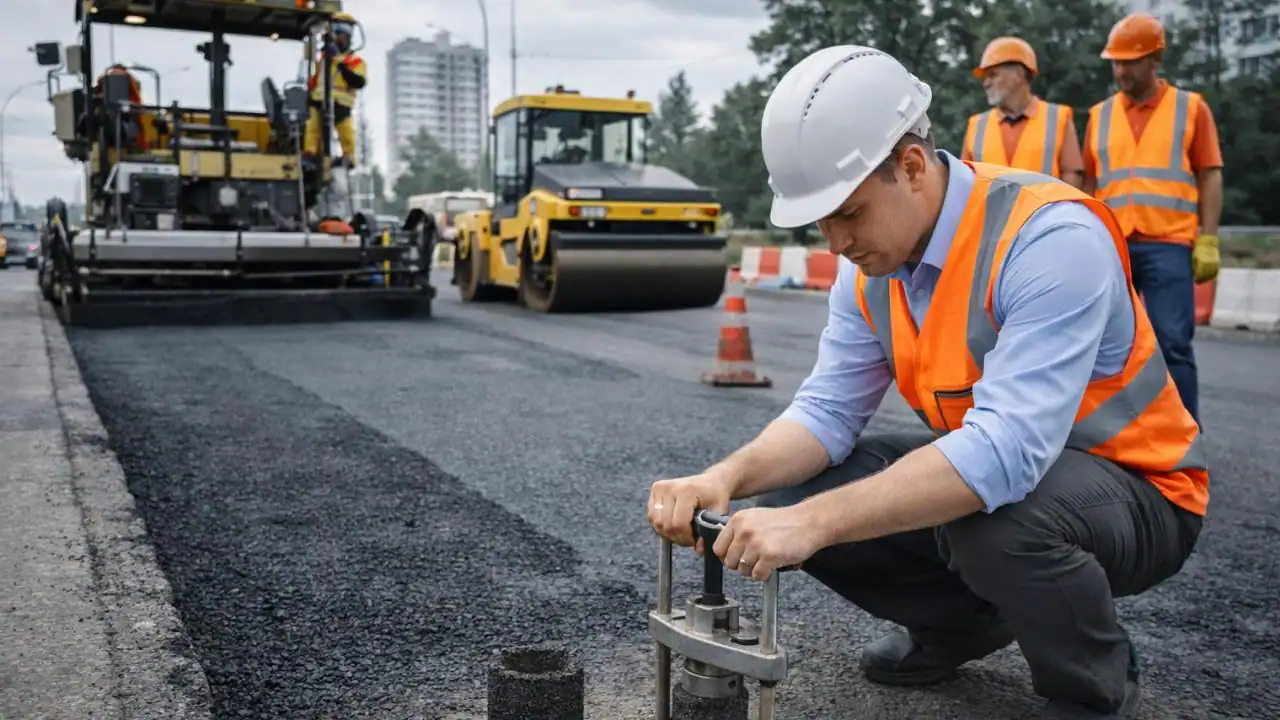
Road construction quality control: inspection of materials, subgrade, base layers, asphalt concrete, drainage, and road geometry. Control methods and typical defects.
The quality of a road is not determined only at the stage when the final asphalt layer is laid. It is formed progressively – from the preparation of the subgrade and base layers to pavement construction, drainage installation, and final acceptance of the completed works.
Road construction quality control is a system of inspections, measurements, and documentation used to verify whether the completed works comply with the design documentation, technical requirements, and applicable standards.
For the client, this is not only a matter of compliance with the design. The quality of the base layers, drainage, compaction, and road construction materials directly affects pavement durability, rutting and cracking, resistance to seasonal deformation, and the cost of future repairs.
In practice, quality control should not be performed only after the works are completed. Critical parameters must be checked during construction operations, while any detected deviation can still be corrected without costly rework.
Road quality control covers several interconnected areas: verification of initial documentation, incoming inspection of materials, geodetic measurements, operational control of construction processes, and acceptance of completed work stages.
The specific scope of inspections depends on the type of facility, pavement structure, design solutions, materials used, and the requirements of the technical documentation.
| Stage | What Is Controlled | What Is Checked |
|---|---|---|
| Preparation | Design and initial data | Elevations, axes, quantities, compliance with working documentation |
| Earthworks | Subgrade | Elevations, width, slopes, moisture content, and compaction |
| Base | Pavement base layers | Material, thickness, density, and geometry |
| Asphalt concrete | Mix and paving | Temperature, thickness, width, density, and evenness |
| Drainage | Ditches, channels, and pipes | Slopes, elevations, hydraulic capacity, and installation quality |
| Acceptance | Completed road section | Actual parameters, defects, and as-built documentation |
New asphalt may look perfect immediately after paving, but this does not necessarily mean that the road structure has been built to a high standard.
One of the common causes of premature pavement failure is insufficient bearing capacity of the underlying layers. If the subgrade or base is inadequately compacted, heterogeneous, or excessively wet, traffic loads are distributed incorrectly. As a result, settlement, cracking, rutting, and other deformations may develop over time.
This is why quality control should begin before the wearing course is laid.
Actual elevations and slopes, compliance of the material with the design, layer uniformity, and the degree of compaction are especially important. Instrumental and laboratory testing methods may be used when necessary.
Road quality largely depends on the quality of the materials used, so incoming inspection should not be limited to checking accompanying documents.
For crushed stone, sand, mineral filler, asphalt concrete mixtures, cement, bituminous materials, and other components, compliance with the project requirements and technical documentation is verified.
Depending on the material, physical and mechanical properties, particle size distribution, moisture content, density, and other parameters may be assessed.
It is especially important to compare:
what is specified in the design → what is declared by the supplier → what is actually delivered to the site.
If a material does not meet the specification, the issue should be identified before it is incorporated into the road structure.
The subgrade is the basic element of the road structure. Errors at this stage may become visible only after several overlying layers have already been constructed, when correction becomes significantly more expensive.
Geometric parameters, elevations, cross slopes, soil quality, and the degree of compaction are checked.
Special attention is paid to:
— embankment sections;
— cut sections;
— transitions between different soil types;
— utility crossing areas;
— zones with increased moisture;
— road widening and junction areas.
If compaction is unsatisfactory, placing subsequent layers should not be considered a way to “hide” the problem. A weak subgrade will continue to affect the performance of the entire road structure.
After the subgrade is prepared, the pavement layers are constructed. Depending on the pavement design, these may include various base and subbase layers, followed by the asphalt concrete pavement.
At this stage, not only the materials are checked, but also the thickness of each layer, elevations, slopes, distribution uniformity, and compaction.
Actual layer thickness is particularly important. Insufficient thickness may reduce the bearing capacity of the entire pavement structure, even if the finished section looks acceptable visually.
Control should be carried out at the inspection points and sections specified in the quality control program and design documentation.
Road geometry is critically important.
Even high-quality materials cannot compensate for actual elevations, widths, or cross slopes that do not comply with the design.
Geodetic control may include checking:
— the road centerline;
— the longitudinal profile;
— cross sections;
— elevations;
— carriageway width;
— slopes;
— the position of structural elements.
The purpose of quality control is not simply to confirm that “the work has been completed,” but to identify deviations that may affect the reliability of the facility.
The type of defect depends on the stage of construction.
| Section | Possible Problems |
|---|---|
| Subgrade | Insufficient compaction, settlement, incorrect elevations |
| Base | Non-uniformity, insufficient thickness, low density |
| Asphalt concrete | Insufficient compaction, unevenness, joint defects |
| Edges and Connections | Failure of connections, geometric deviations |
| Drainage | Reverse slopes, clogging, elevation errors |
| Road Geometry | Deviations in centerline, width, and slopes |
| Materials | Non-compliance with design requirements |
A particularly important principle is defect prevention. The earlier a problem is identified, the smaller the scope of rework and the lower the associated costs.
The results of construction quality control should be verifiable.
Depending on the type of work, documentation may include inspection acts, logs, measurement reports, material certificates, as-built drawings, photographic records, and other documents required by the project and the adopted quality control procedures.
In practice, the value of documentation is not limited to formally confirming that the work has been completed. It makes it possible to trace:
what was done → which materials were used → which technology was applied → which parameters were actually achieved → who performed the inspection and when.
Independent quality control is especially useful in projects where the client does not have its own technical team or wants an additional objective assessment of the contractor’s work.
It may be particularly relevant for:
— construction of new roads;
— reconstruction of existing roadways;
— major infrastructure projects;
— bridge and overpass construction;
— projects involving several contractors;
— works financed by investors or financial institutions.
The control format should be selected according to the project objectives. For one project, periodic inspections may be sufficient, while another may require the permanent presence of a technical specialist and systematic documentation of all control activities.
Road construction quality control is part of comprehensive engineering support for a project. Depending on the scale and objectives of the facility, technical supervision, geodetic works, financial and technical control, and construction project management may also be required.
Technical supervision of bridges and roads provides systematic control over road and bridge construction works, compliance with design solutions, the quality of materials used, and construction technologies.
For controlling the geometry of the facility, coordinates, elevations, and slopes, geodetic services are used.
Where simultaneous control of technical parameters and the cost of completed works is required, financial and technical control can be applied.
For large construction projects, comprehensive coordination of works, schedules, and project participants may be carried out within the framework of construction project management.
This approach makes it possible to control not only the quality of individual construction operations, but also the implementation of the road project as a whole – from site preparation and base construction to completion of works and final acceptance.
An effective quality control system begins before the contractor starts work on site. First, control points, responsible specialists, procedures for recording results, and acceptance criteria are defined.
Quality control is then integrated directly into the construction process: materials are checked before use, concealed works – before they are covered by subsequent layers, geometric parameters – during construction, and completed sections – before acceptance.
This approach makes it possible to move from reacting to defects that have already occurred to managing quality throughout the entire construction life cycle.
Road construction quality control is a consistent system of inspections rather than a final visual check of the finished asphalt surface. Road quality is formed at every stage – during soil preparation, base construction, asphalt concrete production and paving, drainage installation, and geodetic works.
The most effective control model allows deviations to be identified before they are concealed by the next structural layer. This reduces the risk of rework, helps ensure compliance with the design, and provides the client with a documented and verifiable picture of the actual condition of the facility.
Quality control usually covers design documentation, materials, earthworks, base layers, pavement, geometry, drainage, individual engineering structures, and acceptance of completed stages.
Depending on the project delivery model, quality control may be performed by the construction contractor, the technical client, an engineering company, or an independent specialist. The specific arrangement is defined by the contract and project documentation.
The actual pavement parameters and their compliance with the design requirements are checked, including geometry, thickness, evenness, compaction quality, and other characteristics specified in the quality control program.
Insufficient compaction can reduce the bearing capacity of the layer and lead to deformation of the road structure. For this reason, compaction control should be carried out before subsequent layers are constructed.
Yes. Geodetic measurements make it possible to control the road centerline, elevations, width, and slopes and to identify deviations from the design geometry at an early stage.
Construction quality control is a broader system for verifying the compliance of works and materials with established requirements. Technical supervision is one of the organizational forms used for systematic quality monitoring throughout the project.
This is significantly less effective. Many parameters should be checked at intermediate stages while the structural layer is still accessible and detected defects can be corrected without major rework.
The actual condition should be documented, the nature and extent of the deviation should be determined, and its impact on the design parameters should be assessed. After that, a technical decision on corrective measures can be made.
 0
0 Похожие статьи